Cotton T-shirts
Direct colour and white-underbase printing for fashion, merchandise and branded garment programs.
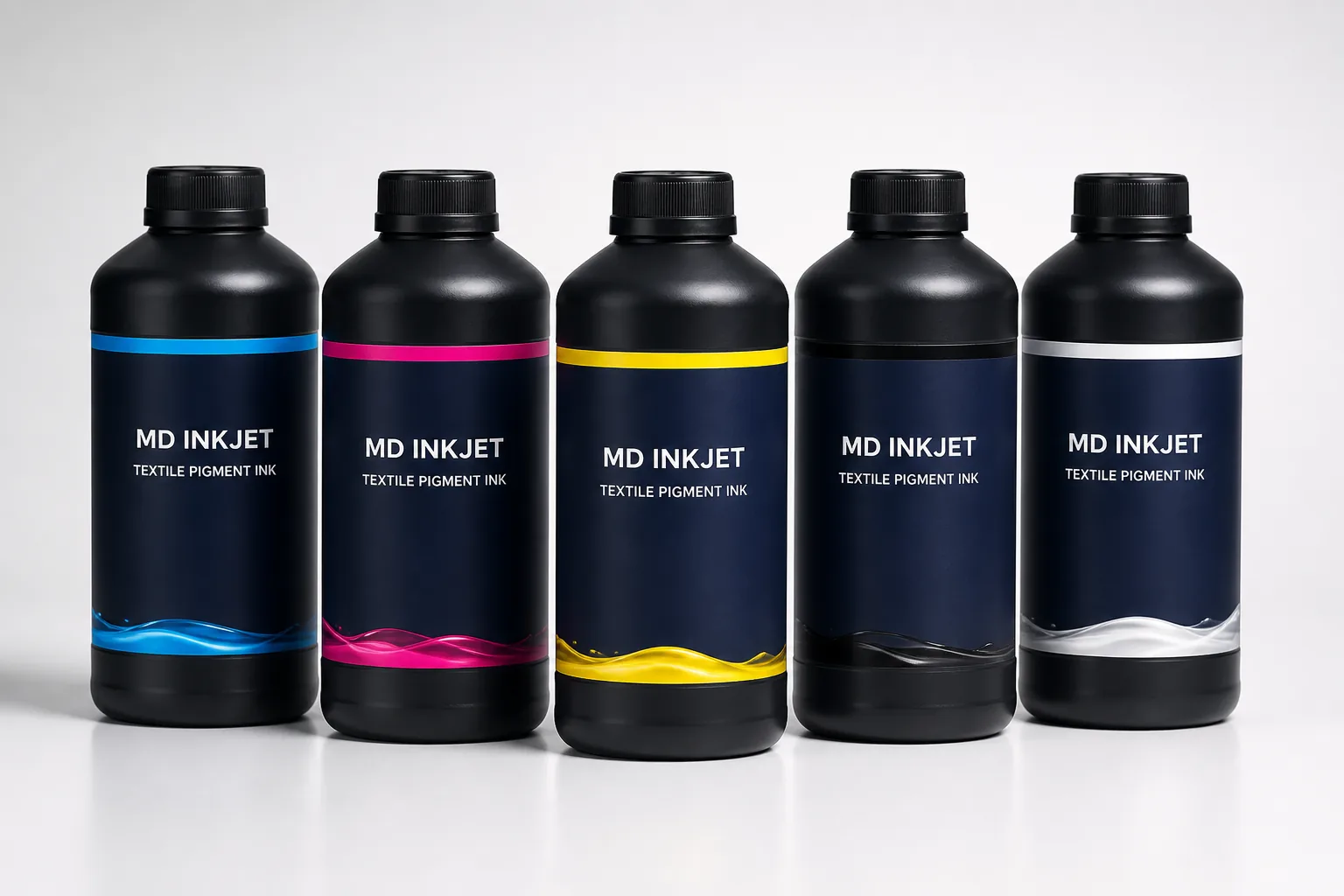
DTG PIGMENT INK / CMYK + WHITE
Water-based pigment ink for printing directly onto cotton garments. CMYK color reproduces fine artwork and gradients; a dedicated DTG white ink supports dark garments. Built for personalised apparel, cotton collections and print-on-demand production.
Request DTG ink samples ↗1 kg per bottle · 20 bottles per carton · 48 cartons per standard pallet
FROM INK TO APPLICATION
DTG is strongest on cotton and cotton-rich products where detail, softness and breathability matter.
DTG focuses on cotton and cotton-rich blends. Dark products usually need matched pre-treatment and white ink; pure polyester, waterproof coatings, umbrellas and heat-sensitive synthetics are not the primary application for this DTG pigment system. Pre-treatment liquid is not currently offered.
DTG INK CORE ADVANTAGES
Engineered around the complete DTG system: reliable piezo jetting, pre-treatment control, white opacity, accurate color and a soft, breathable garment result.
Nano-scale pigment dispersion and multi-stage fine filtration help reduce nozzle-block and dry-head risk while supporting smooth continuous production.
Fluid properties are developed for qualified Epson I3200 and XP600 systems as well as Ricoh and Kyocera industrial platforms.
Titanium-dioxide settling is designed to remain loose, allowing correct agitation or circulation to restore uniformity without forming hard deposits that can damage white channels.
Matched viscosity and surface tension support rounded droplets, reduced satellites and overspray, plus controlled reproduction of fine lines, gradients and photographic images.
Designed to minimize bleeding, feathering and white-ink migration when used with a qualified pre-treatment application.
Controlled ink holdout helps prevent excessive white penetration into the fiber, supporting a uniform, opaque base and brighter color without a grey cast.
Ink bonds within the cotton-fiber structure, preserving more of the garment's original softness and breathability without the adhesive-film feel associated with transfer printing.
After correct curing, a controlled resin film supports stretch-cotton movement without easy cracking.
High opacity supports strong coverage on dark cotton garments.
Saturated color, a solid black point and ICC-profile-ready reproduction support photographs, gradients and precise color targeting.
Pigment and binder are designed to fix securely to cotton fibers under a qualified pre-treatment and curing process.
Comparable published data lists wash, wet-rub and dry-rub performance at grade 4–5. M-INKJET release targets remain grade-, garment-, pre-treatment-, curing- and test-method-specific.
Critical: DTG durability depends heavily on pre-treatment amount, application uniformity and curing conditions. Ink performance cannot compensate for an incorrectly prepared garment.
Developed mainly for 100% cotton, cotton-linen and high-cotton blends. Pure polyester is not the recommended primary application for this DTG pigment system.
A 150–170°C heat-press or oven range is presented as a system reference; the released condition must prevent tack or re-tack and be confirmed on the actual garment.
DTG keeps the print conversation close to the garment: no transfer film or powder stage, a softer cotton-first result and an efficient route for on-demand artwork.
Designed as a low-VOC water-based pigment system with stable sealed storage. White ink requires scheduled agitation or circulation; a 12-month shelf-life target, OEKO-TEX® support, textile-export suitability and any direct-skin-contact statement must be confirmed by the applicable MSDS, TDS, test report, certificate scope and lot storage conditions.
In a self-dispersed colorant, hydrophilic or ionic functionality is introduced onto the pigment surface. The modified surface improves affinity with the aqueous phase and creates repulsion between neighbouring particles, helping them remain separated instead of forming larger agglomerates.
Qualification note: rubbing grades, wash temperature, 150–170°C curing and 12-month storage are target or reference values until aligned with the released MD TDS, COA, MSDS, wash/rub report and current certificate scope.
DTG COLOR SYSTEM
The final result depends on the complete DTG system: garment construction, pre-treatment, white layer, color profile and curing conditions.
The core color set for process-qualified direct-to-garment printing.
Developed for textile inkjet production and the intended garment surface.
Image quality is qualified through the selected printhead, waveform and RIP profile.
For dark garments, the white layer provides the opacity foundation beneath the CMYK image.
Dark-garment white-ink workflows use the qualified DTG pre-treatment before printing.
Color, durability and hand feel are evaluated after printing and curing on the target fabric.
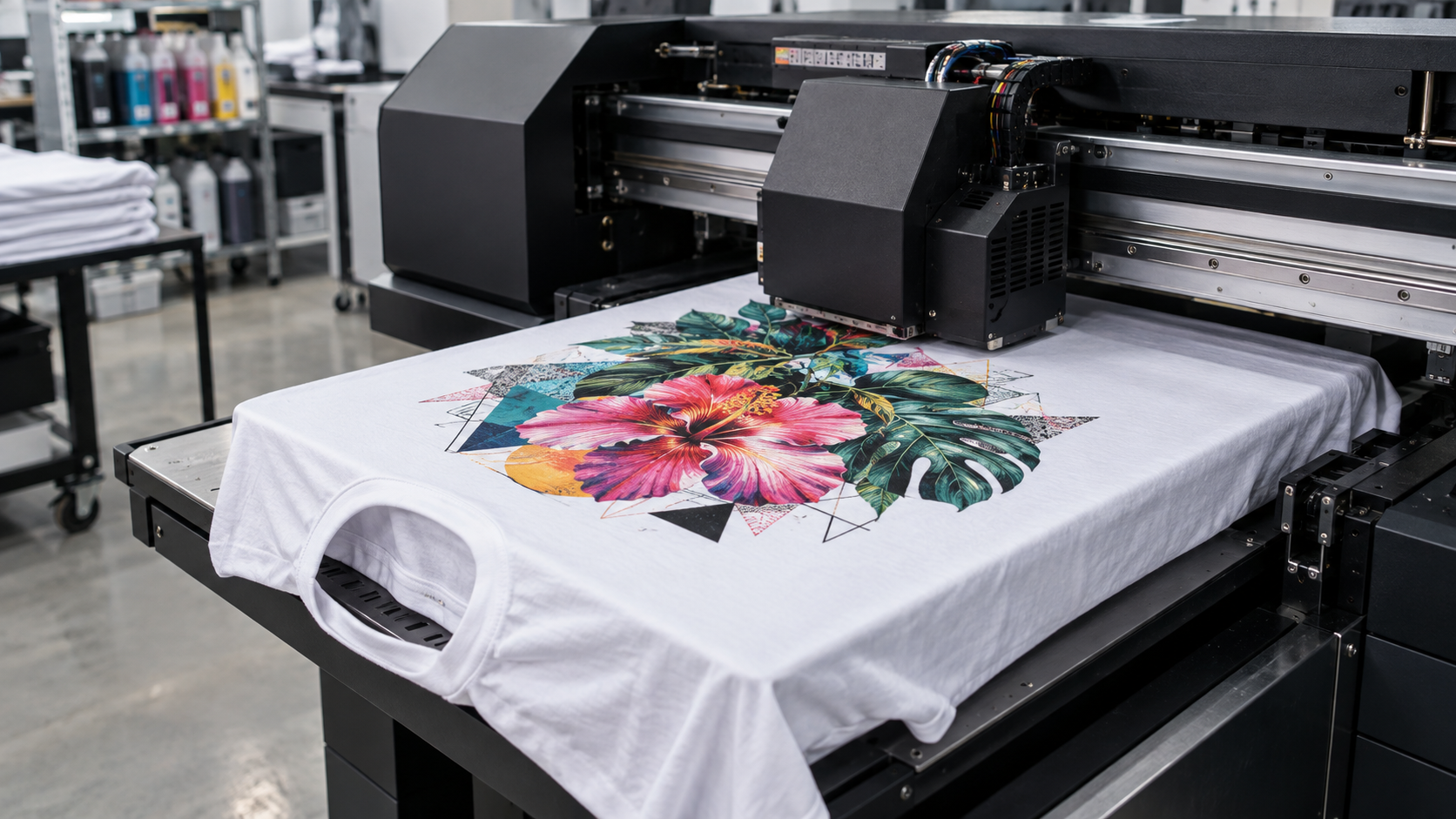 DTG DIRECT PRINTING · COTTON GARMENT
A direct-to-garment production view: the print carriage deposits the image onto the prepared cotton surface, making jetting stability, white and colour control, fabric preparation and curing part of the same qualification route.
DTG COLOR INK PLATFORMS
Printhead compatibility is confirmed against the complete printer, ink-delivery path, waveform and textile process—not through a blanket universal-compatibility claim.
Qualified seriesDX5 · DX7 · 5113 · 4720 · I3200 · S3200
High-flow platformsStarFire 1024 · Ricoh G5 / G6
Industrial platformsKonica 512i / 1024i · Kyocera KJ4B
DARK-GARMENT DTG PROCESS
On dark garments, pre-treatment and white ink prepare the foundation for the CMYK image. Light-garment workflows are qualified according to the actual fabric and print requirement.
Confirm the target fabric, construction and intended finished result.
For the qualified dark-garment workflow, apply and prepare the DTG pre-treatment evenly.
Build the white underbase and CMYK color image through the selected print setup.
Set final conditions against the ink system, garment and target performance.
DTG INK · REFERENCE DATA
Use these published market ranges to plan a sample. Final performance belongs to the selected M-INKJET grade, garment, pre-treatment, printer and curing method.
Reference status: these figures are adapted from comparable published DTG data. Wet-rub and wash results are especially sensitive to garment preparation and curing; confirm the selected M-INKJET grade and finished garment against the intended test standard.
FAQ
DTG pigment ink is a water-based textile ink printed directly onto garments, primarily cotton and cotton-rich blends. CMYK reproduces the image; a dedicated white ink and matched pretreatment support dark garments before curing.
The main focus is cotton and cotton-rich blends. Fabric finish, pre-treatment and curing affect results. Do not assume standard cotton DTG ink is suitable for pure polyester.
Matched pre-treatment helps control white-ink penetration and the image boundary. Validate application amount, drying and final cure together with the ink and garment.
DTF and DTG white inks are different application systems. Select a dedicated DTG grade for the printer and garment process.
Common finished-garment methods include ISO 105-C06 for laundering, ISO 105-X12 for dry and wet rubbing, ISO 105-E04 for perspiration and ISO 105-B02 for artificial-light fastness. US-market specifications may use AATCC TM61, TM8, TM15 and TM16.3. Test after the agreed pre-treatment, print, cure and conditioning procedure.
Pre-treatment chemistry and application weight, garment construction, white and colour ink load, curing temperature and dwell time, conditioning, test option and rating scale can all change the result. A grade without those conditions is not a complete or directly comparable performance claim.
Compare nozzle checks, white coverage, fine detail and hand feel on your own garments, then assess wash and rub performance after the agreed curing procedure.
DTG COLOR INK MATCH
Share your print platform, garment, pre-treatment route and target hand feel.
Build product RFQ ↗Ask about handling guidance, available safety and batch documents, and the certification scope for your selected ink grade.