ABOUT M-INKJET
Materials for
textile output.
M-INKJET is an export-focused brand specialising in water-based DTF and DTG textile inks. With dependable supply and a strong performance-to-cost balance, we provide reliable digital textile-printing consumable solutions for print factories, POD businesses and ink wholesalers worldwide.
Explore products ↗
B2B COMPANY ADVANTAGES
Built around
your production.
Manufacturing capability, print-process qualification and commercial coordination are shown as one clear supply route.
HANGZHOU MIDA CHEMICAL CO., LTD. began with international trade in organic pigment powders. As demand for textile printing has expanded and evolved, the company started its transition into environmentally conscious textile inks in 2020. We believe DTF and DTG applications will continue to mature, creating more dependable opportunities for textile decoration and production.
Today, HANGZHOU MIDA CHEMICAL CO., LTD. is the primary commercial entity shown on this website and the sales office for M-INKJET water-based pigment ink systems. We coordinate DTF transfer ink and DTG direct-to-garment ink projects—including CMYK colour ink and dedicated white ink—for distributors, print factories and customisation businesses.
Our role covers product matching, sample coordination, quotation, export communication and repeat-supply discussions. Each project is reviewed around the complete production route—ink, printhead, ink delivery, RIP and colour workflow, film or garment, curing conditions and intended textile application—so the buyer receives a relevant qualification plan instead of a generic catalogue response.
ink experience
Long-term formulation and manufacturing experience focused on dependable textile ink supply.
pigment colorants
A mature self-dispersed pigment-colorant platform supports dispersion control, storage stability and repeatable water-based ink formulation.
print platforms
Fluid properties are tuned around printhead, printer, ink path and production conditions.
per month
Production capacity supports volume orders, planned replenishment and distributor supply programs.
Rapid dispatch is available for qualified standard products and confirmed stock; custom orders follow the agreed production schedule.
OEM · distributor
Product matching, label, packaging and commercial format can be discussed around the application and order volume.
No.1 Building, No.226 Dalinshan Rd, Dongzhou Street, Fuyang District, Hangzhou City, China
DTF pigment ink · DTG pigment ink · CMYK colour ink · dedicated white ink
MANUFACTURING / FOSHAN, CHINA
A new facility.
Experienced people.
Our newly built factory brings a fresh production base to M-INKJET's DTF and DTG textile ink supply. The team's 10 years of industry experience informs material selection, formulation and application support.
From mature self-dispersed pigment colorants to packed ink, explore the production checkpoints and quality questions behind your next order.
Explore quality control ↓THE PRODUCTION ROUTE
Six checkpoints from incoming materials to export packing.
- 01 / MATERIALS
Start with the colorant.
Review pigment-colorant identity, incoming lot information and formulation suitability, with separate requirements for colour and white ink.
Material identity · supplier lot - 02 / FORMULATION
Control the fluid.
Match weighing, blending and fluid properties to the ink grade. Temperature and mixing conditions matter to repeatability.
Weighing · blending · process record - 03 / FILTRATION
Prepare for jetting.
Review filtration, coarse particles and entrained air before filling. Validate the finished ink with the intended printhead and ink path.
Filterability · particle control - 04 / FILLING
Protect the finished ink.
Check container suitability, fill weight, closure and label information. Keep the product grade and batch identity together.
Fill weight · seal · batch label - 05 / RELEASE
Connect the batch to its record.
Agree the release criteria, review recorded results and define retained-sample checks for the supplied formulation.
Batch results · COA · retained sample - 06 / DISPATCH
Plan the complete load.
Confirm carton count, pallet arrangement and transport documents against the order, destination and selected carrier.
20 bottles / carton · 48 cartons / pallet
INSIDE THE FACTORY
Three workspaces.
One ink route.
These on-site photographs show the production workshop, laboratory and printing test area. Explore the related packing and quality guides below.
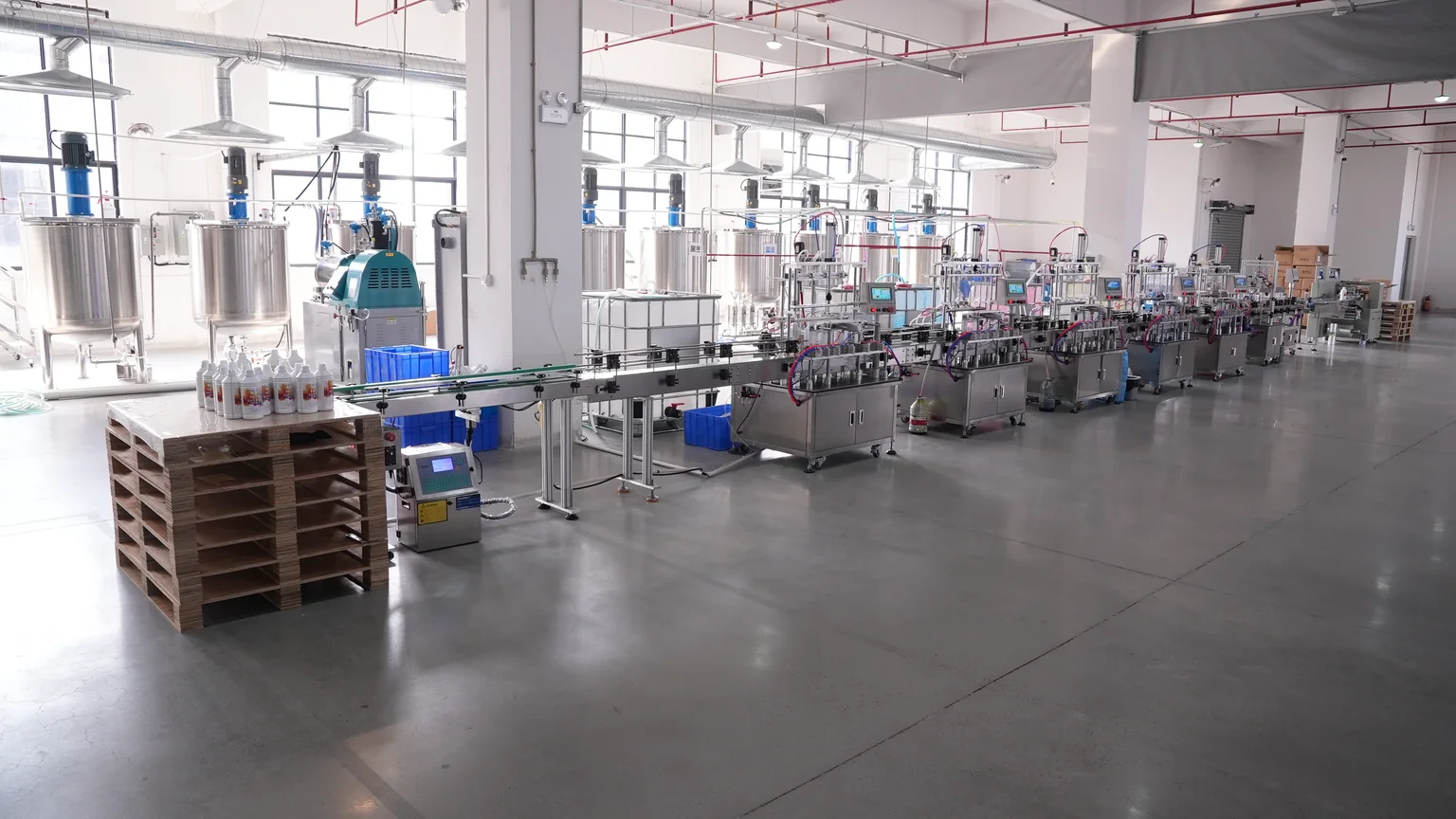
A view of the workshop with blending tanks and filling equipment. See the export carton and pallet details for the finished ink.
Explore packaging & pallet loading
A view of the laboratory workstations and ink samples. Explore the evaluation framework for ink properties and storage behaviour.
Explore ink quality testing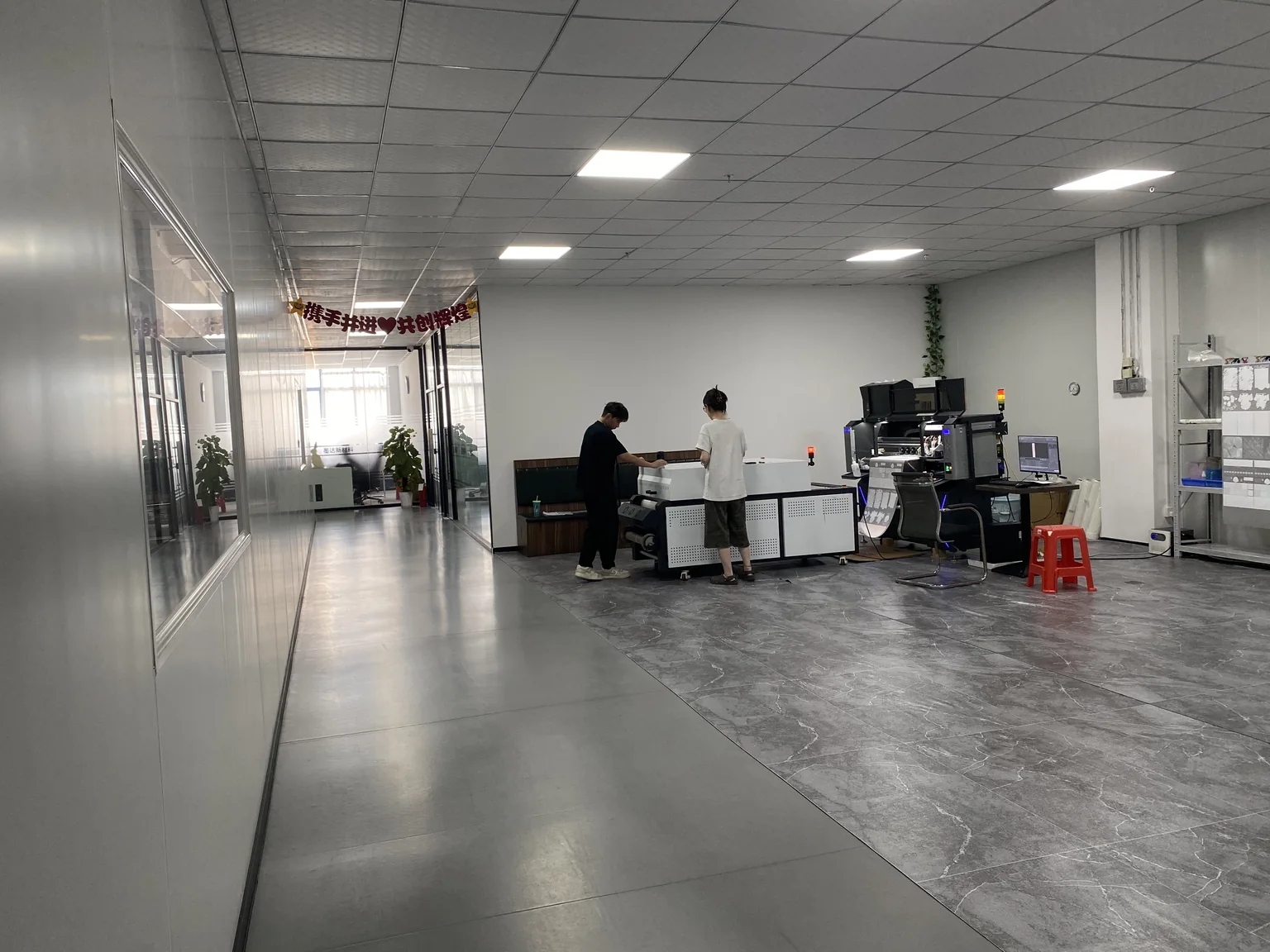
A view of the printer-test area. Review the checks for nozzle condition, continuous printing and finished-print performance.
Explore print & transfer evaluationINK QUALITY / FROM BATCH TO PRINT
Consistency you
can evaluate.
Initial measurements, storage behaviour and printed results belong in the same evaluation. Test scope, frequency and available records are confirmed for the selected ink grade.
FOUR-LAYER EVALUATION
Define the applicable methods, frequency, acceptance criteria and available records for each ink grade.
- 01 / INPUT
Materials & process
Review colorant identity, supplier lot, formulation, filtration and batch traceability.
- 02 / INK
Properties & ageing
Check fluid properties, particle distribution, storage stability and white-ink redispersibility.
- 03 / PRINTER
Jetting & restart
Evaluate nozzle condition, continuous printing and restart on the intended printhead and ink path.
- 04 / PRINT
Output & release
Compare colour and opacity; review wash, rub, adhesion and stretch against agreed application conditions.
DETAILED CHECKPOINTS / SELECTED INK GRADE
Viscosity & surface tension
Evaluate viscosity, surface tension and pH under defined conditions; include conductivity, density and solids where relevant to the formulation.
Record the test temperature and method.Particle size & distribution
Compare particle-size distribution and coarse-particle behaviour before and after storage. When DLS is suitable, report the average hydrodynamic size and PDI with the measurement conditions.
A mean particle size alone does not establish jetting reliability.Age, then measure again.
Combine real-time retained samples with formulation-specific accelerated storage. Recheck fluid properties, particle size, colour and jetting after exposure.
Accelerated screening supports, but does not replace, real-time shelf-life evidence.Compare each colour to a reference.
Measure standardised prints against an agreed reference using L*a*b* and a defined colour-difference formula, such as Delta E 00. Keep ink laydown, substrate and curing consistent.
Agree measurement conditions and tolerances with the order.Opacity & redispersibility
Review whiteness, coverage, settling and the ability to return to a uniform suspension. Check performance after the specified agitation or circulation routine.
Evaluate the cured underbase on the intended dark fabric.Follow the ink through the printer.
Evaluate nozzle checks, continuous printing and restart behaviour, then assess wash, wet and dry rubbing, adhesion and stretch on the completed print.
For DTF, record the ink, film, powder, fabric and transfer settings.ORDER / BATCH / DELIVERY
A clear record behind the shipment.
For supplier qualification, request the available product specification, batch COA, safety data and application-test conditions. Confirm the required document set before ordering.
DOCUMENTATION & COMPLIANCE
Evidence matched
to the ink.
Buyer documentation is organised by product grade, production batch and destination market so safety, release and certification scope can be reviewed without ambiguity.
- 01Identify the exact ink
Match the DTF or DTG formulation, colour set and intended printer before reviewing documents.
- 02Connect evidence to the order
Separate general product guidance from batch-specific COA and market-specific requirements.
- 03Check certificate boundaries
Confirm the holder, named products, certificate number, validity period and applicable restrictions.
PRODUCT-SPECIFIC CONTROLOnly documents that identify or explicitly cover the selected ink grade are used for qualification and public claims.
BUYER DOCUMENT PACKMSDS · COA · CERTIFICATE SCOPEMatched to product identity, batch and intended market.
- Product identification
- Exact ink grade and colour set
- Safety data
- MSDS for handling, storage and transport review
- Batch release
- COA matched to the supplied production batch
- Certificate scope
- Limited to products expressly named or covered by the document
- Validity review
- Holder, article name, certificate number and validity checked
- Destination documents
- Aligned with the buyer country and intended application
MSDSSafety & handlingCOABatch releaseCERTIFICATE SCOPEProduct specificPRODUCT GUIDEApplication & care
OEKO-TEX® ECO PASSPORT or any other certification is referenced only when the current document explicitly covers the selected ink grade. Ask the M-INKJET team to confirm the applicable scope for your order.
FACTORY CERTIFICATE REFERENCESScope you can inspect.
These factory-held documents are historical references. The holder and full scope remain visible in the original PDF, and renewed, product-matched evidence is required before any current certification claim is made.
OEKO
TEX®DTFHISTORICAL
DOCUMENTBJ150 191216 · EXPIRED
TEX®DTFHISTORICAL
DOCUMENTBJ150 191216 · EXPIRED
DTF PIGMENT INK · HISTORICAL REFERENCE
OEKO-TEX® ECO PASSPORT
- Holder
- Factory certificate holder — see original PDF
- Certificate
- BJ150 191216
- Scope
- DTF pigment ink in orange, blue, green, red, black, cyan, magenta, white and yellow; named Epson printhead variants
- Validity
- Expired 30 November 2025
- ZDHC
- MRSL Conformance Level 3
OEKO
TEX®DTGHISTORICAL
DOCUMENTBJ150 170229 · EXPIRED
TEX®DTGHISTORICAL
DOCUMENTBJ150 170229 · EXPIRED
DTG PIGMENT INK · HISTORICAL REFERENCE
OEKO-TEX® ECO PASSPORT
- Holder
- Factory certificate holder — see original PDF
- Certificate
- BJ150 170229
- Scope
- DTG pigment ink in black, blue, cyan, green, magenta, orange, red, white and yellow; named Epson and industrial printhead variants
- Validity
- Expired 31 August 2026
- ZDHC
- MRSL Conformance Level 3